
Table of Contents
Sorting through endless to-do lists can feel overwhelming, especially when urgent deadlines pile up next to long-term projects.
The Eisenhower Matrix helps you separate what truly matters from what simply feels pressing, so you can focus your time and energy where it counts most.
This proven framework divides your tasks into clear categories, making it easier to see which actions deserve your attention and which can wait or be delegated.
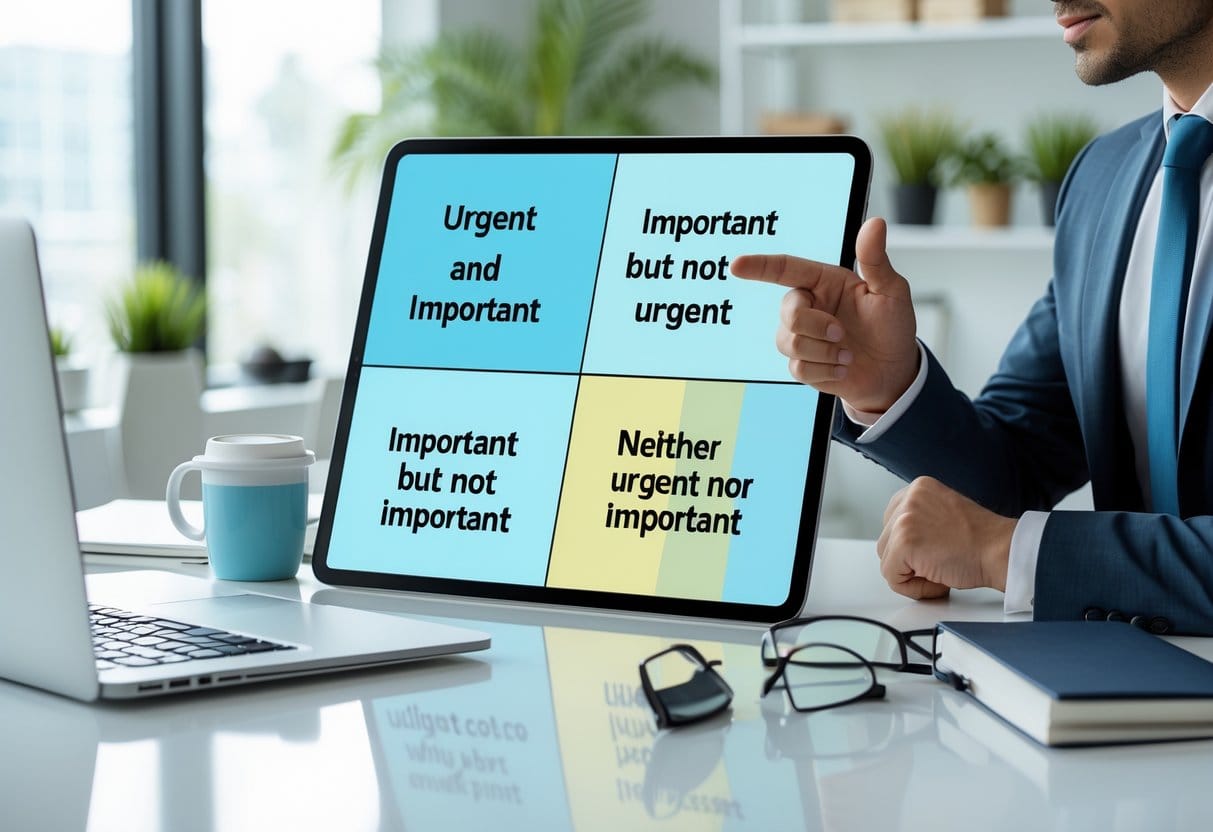
Understanding the real difference between urgent and important tasks is a game changer for productivity.
When you apply the Eisenhower Matrix, you’re not just working through a list; you’re making conscious decisions that move you closer to your goals and reduce daily stress.
Key Takeaways
- Learn how to prioritize daily and long-term tasks effectively.
- Discover strategies to delegate or eliminate non-essential actions.
- Use the Eisenhower Matrix to achieve your goals and manage your time wisely.
Understanding the Eisenhower Matrix

The Eisenhower Matrix is a structured way to sort your tasks by their urgency and importance, helping you focus on what truly matters.
This method enables you to distinguish between what demands immediate attention and what will bring long-term value.
History and Origins
The Eisenhower Matrix, also known as the urgent-important matrix, is named after Dwight D. Eisenhower, the 34th President of the United States.
Eisenhower, who was also a five-star general during World War II, was known for his focus on effective leadership and time management.
He is often quoted as saying, “What is important is seldom urgent and what is urgent is seldom important.”
This approach served as the foundation for what would become the Eisenhower Matrix.
Over time, productivity experts adapted his philosophy into a visual framework, helping people at all levels manage their goals and responsibilities.
The matrix has since been widely adopted as a practical tool in business, project management, and personal productivity.
Its roots in real-world decision-making give it enduring relevance.
How the Matrix Works
The Eisenhower Matrix divides tasks into four quadrants based on two criteria: urgency and importance.
You classify each task you encounter using this grid:
| Important | Not Important | |
|---|---|---|
| Urgent | Do Immediately | Delegate |
| Not Urgent | Schedule/Plan | Eliminate/Postpone |
- Quadrant 1: Urgent and Important – Tasks to do immediately.
- Quadrant 2: Important but Not Urgent – Tasks to schedule for focused work.
- Quadrant 3: Urgent but Not Important – Tasks to delegate if possible.
- Quadrant 4: Neither Urgent nor Important – Tasks to minimize or eliminate.
This system makes it clear what needs your attention first and what can be managed or removed to reduce distractions and stress.
Key Principles
Effective use of the Eisenhower Matrix centers around honest evaluation of your tasks.
Not all urgent things are important, and not all important things are pressing.
Prioritization is a skill you develop by regularly sorting tasks into the matrix and resisting the urge to treat every interruption as a priority.
The method helps you allocate your time and energy, so you work on valuable goals rather than just reacting.
Focus on spending most of your effort in the Important but Not Urgent quadrant.
This is where long-term progress and skill development happen.
By clearly labeling tasks, you minimize time spent on trivial activities and empower yourself to make smarter decisions daily.
Differentiating Urgent and Important Tasks

Identifying which tasks are urgent and which are important can help you allocate your time and effort more effectively.
By understanding the difference, you can prioritize work that supports both short-term deadlines and long-term objectives.
Defining Urgent Tasks
Urgent tasks are activities that demand your immediate attention.
These are often tied to deadlines or consequences if not handled right away.
Examples include responding to critical emails, last-minute meeting requests, or handling emergencies.
You may recognize urgent tasks by their time-sensitive nature.
If missed, these tasks can cause immediate problems for your workflow, clients, or team.
Common characteristics of urgent tasks:
- Require fast action
- Often come unexpectedly
- May interrupt planned work
- Linked to specific due dates
Urgency doesn’t always equal importance.
It is easy to get caught up in urgent activities that do not significantly contribute to your main goals.
Defining Important Tasks
Important tasks move you closer to your key objectives.
These activities have a lasting impact on your professional or personal growth.
Unlike urgent items, important tasks focus on high-value outcomes rather than just meeting deadlines.
You may find these tasks on strategic plans or personal development lists.
Examples include long-term project work, skill development, planning, or building relationships.
Key features of important tasks:
- Have strategic impact
- Align with long-term goals
- May not have immediate deadlines
- Often require focused, distraction-free work
Important tasks can easily be overlooked if your attention is always on what seems urgent.
Prioritizing these ensures continued progress toward what truly matters.
Why the Difference Matters
Distinguishing between urgent and important tasks prevents you from constantly reacting to short-term demands.
This helps you invest your time and energy where it will have the most effect.
If you treat everything as urgent, you risk ignoring tasks that are vital but not time-pressured.
Over time, this can create stress and reduce progress on critical priorities.
Focusing on important tasks—while managing urgent ones—ensures you don’t sacrifice long-term results for short-term fixes.
The Eisenhower Matrix serves as a tool to help you stay balanced and intentional about where your efforts go.
Applying the Eisenhower Matrix to Task Prioritization

The Eisenhower Matrix gives you a framework to prioritize tasks by clarity—separating urgent issues from important goals.
This approach helps you focus on what drives progress and manage daily demands more efficiently.
Identifying and Categorizing Tasks
Start by listing all your tasks without filtering or ranking.
Next, evaluate each task based on two main criteria: urgency (needs immediate attention) and importance (affects your long-term objectives).
Assign tasks to one of four quadrants:
| Quadrant | Description |
|---|---|
| Urgent & Important | Do immediately |
| Important, Not Urgent | Schedule to do |
| Urgent, Not Important | Delegate if possible |
| Not Urgent, Not Important | Eliminate or minimize |
Use clear questions to help you categorize accurately:
- Will this matter by next week or month? (importance)
- Does it demand action today? (urgency)
- Who is impacted if it’s delayed?
Write each task where it fits best—this structure reveals your actual priorities, not just what grabs your attention.
Prioritizing Tasks Effectively
After categorizing, focus on Quadrant I (urgent and important) tasks first.
These are critical issues, like urgent deadlines or crises, that can’t wait.
Next, dedicate consistent time blocks for Quadrant II tasks.
These are vital for future success—such as planning, skill-building, or relationship development—but lack an immediate deadline.
Use the following workflow:
- Address Quadrant I tasks as soon as possible.
- Block off time in your calendar for Quadrant II activities.
- Delegate Quadrant III (urgent, not important) items to others if you can.
- Discard or minimize exposure to Quadrant IV (neither urgent nor important) tasks.
Review your task list daily and update it as priorities shift.
This method maintains focus on what genuinely matters.
Dealing with Competing Priorities
When many tasks compete for your attention, use the Matrix to clarify trade-offs.
Re-evaluate tasks when new demands appear or when deadlines shift.
Rank items within each quadrant to manage limited time or resources.
Sometimes, urgent requests seem important because of external pressure.
Use your own criteria: Ask if completing the task aligns with your larger goals or if someone else can handle it.
Revisit your Matrix weekly to adjust categories for tasks that have become more urgent or important.
If conflicts remain, communicate clearly with stakeholders so expectations remain realistic.
Transparent prioritization helps prevent burnout and supports more sustainable productivity.
Integrating Time Management Strategies

Applying time management strategies helps you put the Eisenhower Matrix into real-world practice.
Establishing clear structures for your workday increases your focus and aids in prioritizing your most valuable tasks.
Time Blocking Techniques
Time blocking is the practice of dividing your day into segments, with each block dedicated to a specific task or type of work.
Rather than shifting constantly between activities, you concentrate on one priority at a time.
To implement time blocking, start by categorizing your Eisenhower Matrix tasks into blocks based on urgency and importance.
Assign a set period to work on each block without interruption.
Common blocks include deep work, planning, meetings, and breaks.
Use your calendar to visually layout these segments.
This method reduces context-switching and keeps you focused on tasks that matter.
Advantages of Time Blocking:
- Reduces distractions
- Increases task completion rates
- Encourages realistic scheduling
- Makes it easier to review how time is spent
You can adjust blocks as needed to fit your natural productivity rhythms.
The Pomodoro Technique
The Pomodoro Technique structures your work into short intervals, usually 25 minutes, called “Pomodoros.”
After each Pomodoro, you take a five-minute break.
Every fourth Pomodoro is followed by a longer break.
This approach is effective for high-priority but demanding tasks in the Eisenhower Matrix.
The promise of a short break makes staying focused more manageable.
Pomodoro Workflow:
- Choose a task from your matrix.
- Set a 25-minute timer.
- Work without interruptions.
- When time is up, mark one Pomodoro and take a 5-minute break.
- After four cycles, take a 15–30-minute break.
You can track the number of Pomodoros required for each task.
This builds a sense of progress and helps refine your estimates for similar tasks in the future.
Using Time Management Tools
Using time management tools makes it easier to organize, track, and prioritize your workload.
Popular digital tools include Trello, Todoist, Microsoft To Do, and calendar applications.
These platforms support the Eisenhower Matrix by letting you visualize, rank, and schedule your tasks.
Most tools come with features like notifications, color coding, and integrations with other apps.
Some platforms offer templates for the Eisenhower Matrix, making it easy to divide your tasks by urgency and importance.
Key criteria when choosing a tool include:
- Simplicity of use
- Integration with your existing systems
- Ability to track progress
- Customization options for your workflow
A good tool not only centralizes your tasks but also supports your time blocking and Pomodoro cycles.
You can set reminders or timers within the app, helping you stay on track and make deliberate choices about your work every day.
Achieving Long-Term and Short-Term Goals

Balancing daily demands with future ambitions requires clear priorities and structured planning.
Using the Eisenhower Matrix helps clarify which actions support your broader objectives while meeting immediate responsibilities.
Aligning Tasks with Long-Term Objectives
To make meaningful progress, start by clarifying your long-term objectives. List out what you want to achieve in one year, five years, or even ten years.
These might include career advancement, learning new skills, health improvements, or financial milestones. With your objectives defined, use the Eisenhower Matrix to filter tasks.
Place actions that directly contribute to these objectives in the “important” sections, especially those that are not urgent. For example, professional development tasks or ongoing projects often belong here.
Review your matrix regularly. Ask yourself if each task aligns with one or more of your stated long-term goals.
Adjust your list as your priorities evolve to ensure your daily work builds toward your desired outcomes.
Setting and Tracking Measurable Goals
Your progress is easier to manage when goals are measurable. Define clear criteria for success for each goal.
For instance, rather than “improve health,” set a goal like “walk 30 minutes a day for 5 days a week.” Use a table or a checklist to monitor your advancement:
| Goal | Metric | Status |
|---|---|---|
| Walk daily | 5 sessions/week | 3/5 done |
| Complete training course | Module completion | 60% |
| Save money for travel | Dollars saved/month | $400/$1000 |
Update your tracking tools weekly or monthly. Recognizing small achievements keeps you motivated and highlights areas needing more attention.
Adjust goals as needed to reflect progress and changing circumstances.
Planning for Sustainable Productivity
Long-term achievement depends on sustainable habits and routines. Overloading your schedule with urgent but unimportant tasks can cause burnout and prevent steady progress toward meaningful goals.
Apply the Eisenhower Matrix by delegating, deferring, or removing items that don’t support long-term objectives. Set regular review periods—for example, every Sunday night—to reassess priorities and redistribute tasks as necessary.
Break major objectives into manageable steps. Use short-term milestones to maintain momentum while avoiding overwhelm.
This keeps both your productivity and motivation at consistent levels for continuous progress.
Delegation and Elimination for Enhanced Productivity
Delegating and removing non-essential tasks are fundamental for streamlining your workload. By focusing on what requires your direct attention and relieving yourself of unnecessary duties, you create more time and energy for high-priority work.
Effective Delegation Techniques
To delegate tasks effectively, first identify which urgent but not important tasks consume your time. These can often be handed off without impacting the quality of your main objectives.
Create a list of such tasks and match them with colleagues whose skills fit the requirements. Clarity is crucial: provide clear instructions, deadlines, and expectations to avoid confusion.
Check in periodically to offer support without micromanaging. Use tools like shared to-do lists or project management platforms to monitor progress efficiently.
Delegation not only frees up bandwidth but also helps develop the skills of others on your team.
Deciding What to Eliminate
Some tasks are neither urgent nor important and serve only as distractions. Examples include unnecessary meetings, redundant reports, or administrative work that offers little value.
Start by auditing your current workflow. List daily activities and mark those with minimal impact toward core goals.
If possible, batch similar low-value tasks or remove them altogether. Use a simple table for assessment:
| Task | Value to Goals | Action |
|---|---|---|
| Checking emails hourly | Low | Reduce/Eliminate |
| Weekly review session | High | Keep |
| Filing old paperwork | Low | Batch/Eliminate |
Eliminate ruthlessly to focus your time where it counts most.
Preventing Burnout Through Smart Workload Management
Balancing what you do and what you delegate or eliminate is essential for preventing burnout. Taking on every task yourself leads to exhaustion and reduces quality over time.
Schedule regular reviews of your workload. Use the Eisenhower Matrix to ensure you are spending most of your effort on tasks that are both important and aligned with your objectives.
If demands continue to exceed capacity, advocate for support or additional resources. Smart workload management supports sustained productivity and guards your well-being.
Advanced Prioritization and Productivity Methods
Targeted strategies help you make sharper decisions about which tasks matter, which can wait, and how to manage both urgent and essential work. Applying structured approaches like the Pareto Principle, deep work, and strategic planning ensures your productivity aligns with your core objectives.
Incorporating the Pareto Principle
The Pareto Principle, or the 80/20 rule, suggests that about 80% of results come from 20% of your efforts. When organizing tasks, identify the few actions that will yield most of your productive outcomes.
Example:
If you have a list of ten tasks, assess which two are likely to drive the most progress toward your goal. Focusing energy on these high-impact tasks means you’re not just busy, but actually moving forward.
To incorporate the 80/20 rule:
- Review your to-do list and mark the top tasks with the greatest impact.
- Delegate or minimize time spent on low-yield items.
- Reassess priorities frequently as circumstances shift.
Clarifying Priorities with Deep Work
Deep work is single-minded focus on complex or meaningful tasks without distraction. By reserving time for deep work, you clarify what needs your uninterrupted attention and what can be scheduled for later.
Consider blocking off sections of your calendar daily or weekly for sustained focus. Before each session, make a short list of work that demands deep thought—such as planning, problem-solving, or creative projects.
- Silence notifications and establish boundaries during these sessions.
- Record your progress to track which types of deep work yield meaningful results.
Deep work not only increases output but also reduces mistakes caused by multitasking or distractions.
Staying Focused and Avoiding Procrastination
Staying focused requires practical strategies to keep you on task and curb the impulse to procrastinate. Start by breaking projects into smaller, clear steps to make them less overwhelming.
Techniques to stay focused:
- Use a timer (such as the Pomodoro Technique) to work in short intervals.
- Set specific goals for each session.
- Remove unnecessary digital and physical distractions.
To avoid procrastination, address reasons for delay—such as unclear instructions or underestimated time. Keep a log of postponed tasks and review why they’re avoided.
Adjust your schedule or approach as needed so small delays don’t become persistent barriers.
The Role of Strategic Planning
Strategic planning aligns your tasks with long-term goals, ensuring day-to-day work supports broader objectives. Begin each week by outlining outcomes you want to achieve, then map your daily actions to fit these targets.
- Prioritize work based on relevance to key projects or milestones.
- Adjust task urgency using frameworks like the Eisenhower Matrix to distinguish between pressing and significant duties.
- Schedule regular check-ins to evaluate progress and fine-tune your plans.
A clear strategic plan prevents distraction by ensuring each action serves a defined purpose, instead of responding only to daily urgencies.
Influence and Legacy of the Eisenhower Matrix
The Eisenhower Matrix has shaped how you organize daily tasks, separate priorities, and structure your workflow. Its focus on urgency and importance continues to influence productivity systems and time management strategies.
Impact on Modern Productivity
The Eisenhower Matrix gives you a clear way to evaluate tasks by sorting them into four quadrants. This approach helps you avoid being reactive and instead encourages you to plan proactively.
You can focus on tasks that actually contribute to your long-term goals rather than simply reacting to deadlines. Many modern productivity tools and project management apps use this principle.
For example, digital to-do lists like Asana and Trello now allow you to label or sort tasks by urgency and importance. This visual structure reduces overwhelm and supports more strategic decision-making in both professional and personal settings.
By deliberately choosing where to direct your energy, you can maintain a balanced workload. This method reduces stress and helps you avoid last-minute emergencies by keeping essential, non-urgent tasks on your radar.
Stephen Covey and Time Management Frameworks
Stephen Covey, author of “The 7 Habits of Highly Effective People,” popularized a version of the Eisenhower Matrix called the Time Management Matrix. Covey’s framework highlights Quadrant II—important but not urgent activities—to help you invest in planning, relationship-building, and self-development.
You can see Covey’s influence in many corporate training programs and personal development courses. His model encourages you to move away from crisis management toward purposeful planning.
It’s common for productivity workshops to have you map your weekly tasks into the four quadrants. This mindset shift leads to a more intentional schedule.
By spending more time on long-term projects, you steadily improve your productivity and reduce the chaos caused by constant firefighting.
Capturing and Scheduling Tasks
Capturing your tasks involves writing down everything competing for your attention. The Eisenhower Matrix gives you a framework to sort these tasks as soon as you capture them.
This helps you quickly recognize what is urgent, what is important, and what can be scheduled for later. Effective scheduling then comes into play.
Instead of simply making a long to-do list, you assign time blocks in your calendar for tasks that are important but not immediate. This prevents them from piling up or being forgotten.
You also clarify which tasks can be delegated or dropped entirely. Using this structure, you minimize mental clutter and develop a more reliable, repeatable planning process.
Your workload becomes easier to manage since you aren’t constantly reacting to the newest demand.
Frequently Asked Questions
The Eisenhower Matrix helps you distinguish between what is urgent and what is important, streamlining your focus and enabling better decision-making. You can use easy-to-apply tools, practical examples, and digital resources to quickly sort your workload and stay organized.
How can one prioritize tasks effectively using the Urgent Important Matrix?
You start by listing your tasks and placing each one into one of four quadrants: urgent and important, important but not urgent, urgent but not important, or neither urgent nor important. Handle tasks in the urgent and important quadrant first.
Items that are important but not urgent should be scheduled and planned. Tasks that are urgent but not important can often be delegated or streamlined.
What are some practical examples of urgent but not important tasks?
Urgent but not important tasks might include interruptions like unscheduled phone calls, most emails, or last-minute meeting requests. These are tasks that demand immediate attention but do not contribute significantly to long-term goals.
Other examples are certain administrative chores or requests from others that do not align with your highest priorities.
How do you decide if a task is urgent or important?
A task is urgent if it requires immediate action or if a deadline is imminent. Importance is defined by how much the task contributes to your key objectives, values, or long-term impact.
Questions you can ask yourself include: “Does this matter for my main goals?” and “Will there be serious consequences if I don’t do this soon?”
What are some strategies for managing tasks that are both urgent and important?
Tackle urgent and important tasks as soon as possible to avoid unnecessary stress. Break large issues into smaller steps to make them manageable.
If several urgent and important tasks arise, prioritize based on deadlines and impact. Prevent recurring crises by identifying root causes and planning ahead.
Where can I find an Eisenhower Matrix template to organize my tasks?
You will find templates on time management websites, productivity blogs, and platforms like Microsoft Excel, Google Sheets, and Notion. Many resources offer free downloadable templates that are ready to use.
Templates typically contain four labeled quadrants, making it easy to sort your daily or weekly tasks.
Are there any mobile apps designed to help with the Eisenhower Matrix prioritization strategy?
Several mobile apps incorporate the Eisenhower Matrix, including specialized options like Eisenhower Matrix and Focus Matrix. Generic to-do apps that allow custom quadrants can also support this strategy.
These apps let you visually sort and manage tasks directly on your smartphone. You can also find browser-based solutions that sync with your devices.
This makes prioritizing tasks more convenient.
Ready to master the Eisenhower Matrix for peak productivity?
Explore these resources:
- Getting Things Done: The Art of Stress-Free Productivity by David Allen
- The 7 Habits of Highly Effective People by Stephen R. Covey
- Essentialism: The Disciplined Pursuit of Less by Greg McKeown